Tag: wellness

  • Don’t make time for the things that matter; shape what matters to you

    This is the third, and currently, planned final installment of the 4 bubbles of life series. You may find the first and second part linked in the words here somewhere.

    We will start with the axioms we defined in the first post.

    Reminder: there are 4 core aspects of a complete life: work, health, leisure and love. There is nothing more, nothing less. You may not have a complete life unless you hit all aforementioned aspects in a sufficient way in your life.

    And the following formula:

    One’s life is k hours/day/week complete if they have spent at least k hours every day for every one of the 4 mandatory aspects of life, averaged over the course of a week.

    Let me give a simple example: Imagine you have spent at least 1 hour taking care of your health, 8 hours (per work day) working, 1 hour with your family and 1 hour relaxing on the couch, every day, every week, over the course of a few months, you have achieved a 1 hour/day/week complete life.

    Well, hear me out on something.

    What if we take the 1 hour relaxing on the couch and 1 hour spent with your family, and do them at the same time? We get 2 hours of relaxing with your family. What if you go out to walk, picnic on some healthy food and play in the park together (assuming kids), and you re-purpose that 1 hour of taking care of your health doing this instead. You have achieved 3 hours of health, leisure and love every day. And now, your k-life score went up from 1 to 3 hour/day/week complete.

    You may think this is impractical, and you may be right. But I hope you got the right idea:

    One who is able to merge his life goals effectively and efficiently will, in turn, achieve a more complete life.

    Merging Work and Leisure: Influencers

    You’ve probably just sighed quite strongly right now. This case study annoys me as much as it annoys you, but trust me, it’s going somewhere.

    And there is a reason why you hate dislike them so much.

    Their lives are more complete than yours.

    If they are smart (and the most popular of them are), they have merged utterly and completely their work and leisure bubbles into a single, cohesive element: their life is their purpose. If they are even more clever, if they do not enjoy the process of:

    • Filming
    • Editting
    • Scripting

    They will offload it to someone else, and they will focus on the core aspect that they enjoy, be that:

    • creative/informational writing
    • education
    • video games
    • sports
    • tech
    • health
    • comedy
    • whatever other niche they love doing

    And they earn money from this. If you ever went back home from a long day of work, just to play a few hours of your favourite game, you probably understand the frustration of learning of PewDiePie, JackSepticEye and others that do not go to work in the first place: they get to play all day long, if they want. Their purpose, again, is doing what they love.

    Work and Leisure into one.

    You can learn from this, but you don’t need to do what they do. Do something that you enjoy doing, earn money from it, and you will never work a single day in your life.

    Merging Work and Health: Athletes

    Here we have another two bubbles that can be connected, depending on the career of choice: sports.

    Many sports require people to get into their peak physical performance, in order to compete against others that will try to achieve the same thing.

    If you’ve ever went to a football match, or tennis, or basketball, you know: you, or your friends, find it entertaining. It’s a leisure activity for them, to watch feats of athletic and strategic prowess.

    But there is a danger lurking in this field: going too far.

    There’s many-a-times you heard of professional fighters, or power lifters, or any other sport where “health” is taken too far, and it is no longer hitting that bubble. They overexert themselves, to get one extra rep, extra kilo, extra kilometer, maybe some performance enhancing (for fields which still allow, like body building).

    There is a point reaching athletic performances no longer takes care of your health, and it should not be considered a merge anymore.

    So thread carefully…

    Merging Work and Love

    I hate the saying “never shit where you eat”. It’s like today’s day and age truly does not want you to be happy, and people collectively don’t want you to be happy either.

    I find nothing more beautiful than to share your purpose with the one you love. I have been a little inspired, on this matter, by the movie Transcendence. I could make a review if you’re interested, but the main gist was this: they worked together, and when they died, they managed to save their consciousnesses in a little haven, where they could spend eternity together.

    Anyway, back on track.

    If you have a partner, or kids, you likely are going through the pain of not seeing them for the vast majority of your every day (or week), because you need to commute, then work, then commute back. At the very least. Then, you are tired, and the time you spend together is limited to few activities, and unfortunately, some of those activities may even be chores (not leisure).

    Wouldn’t it be so much more rewarding to have been, for the vast majority of your day, side by side with your partner, eating together, helping each other on stressful tasks, and achieve something together every now and then, giving you energy and happiness, and reasons to celebrate?

    Of course, there are downsides. You can both be very stressed, and work-related discussions can get more heated than they would with a random co-worker, but at the same time, work stress can reach home anyway. And instead of having the whole day to resolve stressful situations, in the context of both of you having complete knowledge of the circumstance you both are in, you may take your stress out on your partner anyway, without understanding what the other is going through.

    So there are downsides. But those downsides exist anyway, and overall, working together can turn into a life together.

    Which leads me to the following case study:

    Can you have it all?

    I believe the answer is yes. And this is the proof:

    https://www.youtube.com/@BreatheAndFlow
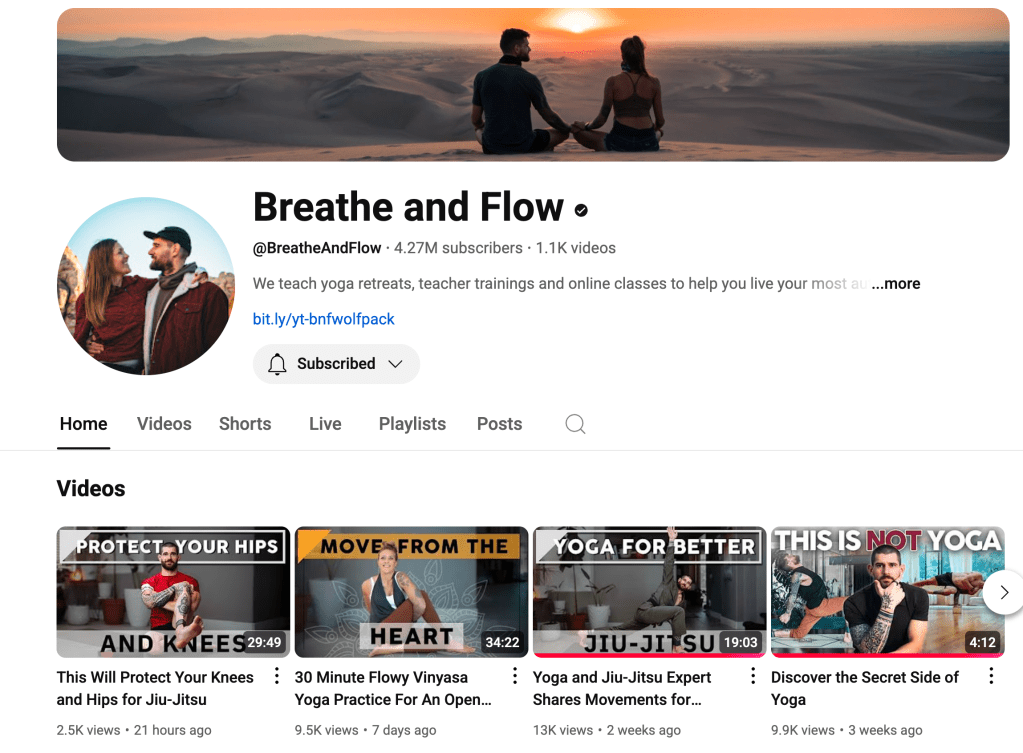
    I hope it’s legal do put this screenshot here, since I did not contact them in any way. Anyway, I do this for you, so you can get annoyed at people living the perfect life.

    For people not aware of who they are, their names are Brie and Flo (I still love the pun in the name of their channel), and they post videos with guided yoga and meditation sessions, where one of them (or both) performs the movements. They sometimes vlog about their lives, they post on instagram, and maybe more stuff, I don’t know.

    They (mostly Flo actually) are who got me to understand what yoga really is, and I would not have been a daily practitioner if not for their channel.

    Literally every hour of every day, their life is their work. And every hour of every day, they do things that benefit their health, because it benefits their channel.

    And they have kids, and they do yoga while their kids play around them and try to follow their movements.

    And from what I hear, they live in an RV and AirBnbs, so they travel around the world to record from different locations.

    Unless you can work remotely, you only travel abroad on holidays. They do everything for a living.

    And they do everything together.

    If this is not a 16 hour/day/week-complete life, I do not know what is.

    Final thoughts: What can you do?

    I hope reading this has been more inspiring than it was depressing. Your work may already be your happy place, or you may already do “healthy physical activity” with your partner, but if you find that you struggle to find time to fit everything in, you are not alone.

    But you can do it all. It’s not easy, and it may be dangerous and scary.

    But it is possible. And at the earliest opportunity, you should do it.

    But how? I’m still working things out myself, so I’m not the best person to give specific advice on it.

    So let’s think together. Think of the intuition, think of the reason why you need to do this. And at the end of the day, it all boils down to how you multi-task your life bubbles.

    Not by doing more things at the same time, but by achieving more with every single thing you do.

  • Why is health advice so contradictory?

    Aldous Huxley, one of my favourite authors (severely underrated by the way), has come up with his gem of a quote:

    Medical science has made such tremendous progress that there is hardly a healthy human left.

    Reminder: he lived between 1894 and 1963, way before aggressive crop hybridisation, ultra-processed food, and “health advice” became the staple of informative conversation that is today.

    I will try to summarise all research observations that science has gathered since I was born: we’re more and more unhealthy.

    As a species, as a planet. And we find so many excuses good reasons for it: we only live once, we gotta experiment and experience everything to be happy. Eat this, drink that, it’s ok to get wasted, it’s fine to lose sleep, one puff won’t hurt, you only live once.

    If you do any of the stuff above, this post is likely not for you. This is for the people that have managed to break out of the vicious unhealthy loops that the vast majority of people find themselves stuck into. It took a lot of time, energy, sweat, money and isolation to get there. Ideally, it took some many kilos as well, but you’ve done it.

    You find all the above habits repulsive, and you never want to return to them again (for now, I’ll get to that in a second).

    But now, you want to improve your health. Since you got this far, you want to optimise. Maybe your sleep is not as good as you want, maybe your abs are not as visible as you’d like, maybe you want to lift more, to bend forward at a better angle, to stand with your back more straight, to keep your skin healthy.

    You need a new obsession, a new avenue to put your energy, time and money into, so you turn improving your health into a vice. One would say “there’s worse vices you could have”, but that is the first step towards addiction.

    Either way, like a coffee person (which I am not), I fully support your choice of addiction, and I am here 100% for you to make the most of it.

    But you need to thread lightly, because there is no science that is less exact than the science of your health.

    Bread: to be, or not to be?

    I’m sure you’ve learned of whole grains. Everyone and their mothers talk about how important they are in our diet. Always choose whole bread rather than the more refined ones. Always have some in your sandwich. It’s useful carbohydrate, full of vitamins and stuff to make you feel good (except if you suffer from coeliac disease).

    You’ve eaten bread your whole life (unless exception). And you think you’re fine.

    But you’re not fine, according to this book: “Wheat Belly”, by Dr. William Davis, whom I’ve just heard he’s a cardiologist. Apparently, the wheat we consume comes from an aggressively hybridised branch of wheat, that produces a very high yield, but is very nutritionally blank. And worse, it has an incredibly high glycemic index (a slice of whole grain bread is higher than a bar of snickers, allegedly), is highly acidic (allegedly lead cause of osteoporosis) and is highly addictive (creates a compound that is highly similar to opioids, allegedly). It is full of case studies, of people who have stopped eating wheat, and have started living much much better lives (allegedly).

    Thing is, I used allegedly a lot. But every doctor, and their mothers, contradict his claims, because they are “not scientific” and “there’s been no studies to suggest this” and “many important vitamins are in bread, you have to eat it”. But I find myself rooting more for Dr. Davis than the mainstream, solely because, idk, it makes sense to me.

    I ate bread a large portion of my life, and many side effects mentioned seem to have happened to me, including an increase in the adipose tissue around my breast area (disproportionate) which, otherwise, I seem to have no other habit that would create this, other than the alleged claims that it leads to this. I drop wheat totally, utterly and completely, and lose so much weight, and feel so good, that I think it’s true what he says.

    But there may be one more factor in here: Ultra-Processed Food.

    Ultra-Processed Ingredients and People: can we work it out?

    When one discards completely all wheat from their diet (and similar, like barley, corn starches, etc), we discard 90% of the products in our supermarket.

    The biggest contributor to everyone’s suffering, allegedly, being Ultra-Processed Food, or UPF for short.

    The first time I learned of this particular concept is from the book “Ultra-Processed People” by Chris van Tuleken. As a physician and researcher, he always thought that the sources or form of the nutrients don’t matter, but how many of each we get in our bodies. And thought that UPF is just normal food.

    But then more research started coming up, and…it said the same thing! So people kept on eating everything that the supermarket had, and they felt just as great as all the studies showed…NOT. Apparently, you add Nestle products in a remote region, and they become obese and malnutrite overnight! This time, research shows.

    But how is this possible? Isn’t research good and honest? Well no, at least, not nutrition and health-related one.

    Investigation (a type of research) shows that, if you follow the money, all studies that view UPF as positive (or even necessary) somehow have some (usually a lot of) sponsorship from the companies that make those products. And they have final say over whether a research is published or not (it’s in their sponsorship contract).

    And the associations that say “eat this” and “drink that” and “it’s healthy for you”? Those ones which receive money only from the governments? Where do you think those government people go when their job contracts expire? To a company with significantly more money, of course!

    So actually, anecdotes and personal case studies seem to be incredibly helpful, because those people have nothing to gain from mentioning how they are feeling from doing something.

    They feel good or bad. No ulterior motives.

    But everyone who has something that they want you to buy, yes please, you only live once, so buy from me.

    Big Pharma/Food/Grifter Companies

    Then what about health advice that you get from the internet, from people, that you get it for free? Your favourite youtuber, or Instagram influencer? Your favourite nutrition book author? Me? What do they have to gain from all of this?

    Money. Most of them, they gain money.

    Look at Athletic Greens. I do not have enough knowledge on this matter, but people that do, they both advise and don’t advise for it. Look only at this story, about your favourite health podcaster, Andrew Huberman, and see how easily an “expert opinion” can be changed when you know what to dangle in front of him:

    Everyone wants to build a niche. Just like every snack bar needs to be different from the others, for branding purposes, people need to advise for different things to improve the same health benefits. But they can’t advocate for what the others are doing, so they change it up a bit, or a lot.

    Your joints are not mobile enough? You need to stretch. Oh no, actually, you need to flex. Heavy weights are better. No, your body, calisthenics is king. Actually, don’t stretch, because these studies show you run better if your hamstrings are a little stiffer. No, actually, you need to stretch your hamstrings, and knees, and hips, and all, because you need to not strain your muscles. Get these supplements, they will help you do better in this workout. They will increase your energy, weight, weight loss, mass, girth. No, don’t do this, your body can do without, be natural.

    Actually, you need to be vegan. No, research shows we found only animal food in this neanderthal’s stomach, so we’re carnivores. A balanced diet is king. Actually, this and this and that are acidic, so your body will AAAAAAAAAAAAAAAAAAAAAAAA.

    Fuck you. Each and every one of you. You don’t know shit, you who learn about it know shit, because you’re learning from grifters who earn money from food and pharma companies. I know nothing, WE KNOW NOTHING BECAUSE OF YOU!!!

    Post mental breakdown: you know more than you know

    Old research is the most pure. No, old research is outdated. This new research is good. Actually, this new research is sponsored.

    I’m tired. You’re tired. Stop listening to the assholes.

    My advice for you: learn how to listen to yourself. Not the addictive self, there is a difference. People tell you not to listen to yourself, but actually, you know more than you know.

    Back before research started to be “ethical”, there was a study done on kids, babies even. Feel free to disregard it, and comment how inhumane it was. But it was mindblowing.

    They got some kids from their mothers, and left them in front of multiple bowls of food. Greens, pastes, fruit, some sweets, some oils. They measured the kids’ biomarkers, and otherwise, just left them to eat whatever they wanted.

    They were able to improve their own health by themselves. Completely and utterly instinctive.

    The most peculiar case study was one of a kid with certain nutritional deficiencies. Very specific, forgot the details, but it was mentioned in the Ultra-Processed People book. Because of that deficiency, they would leave him some type of oil, which the other kids did not have access to, but would help this kid in particular.

    He would drink a lot of that oil by himself, until his nutritional deficiency dropped. Then, he lowered the dose, and stopped taking it altogether. All on his own.

    This study gave me shivers when I read about it. And now, it’s making me cry. We are so out of tune with what we need. There’s so many voices much louder than our owns, that we feel the need to follow them.

    So give yourself a favour, and listen to yourself. But if you come out of this post, and you strawman my arguments by saying “oh, so if I tell myself I want to eat chocolate and drink whiskey on my couch all day, I should do it”…well, what can I say? Do it. Congratulations. I’m happy for you.

    I’m happy you learned something.

  • Making your life efficient

    This is a follow-up post of the 4 bubbles of life, which you can find here. To summarise, there are 4 cornerstones of a complete life:

    • Health
    • Work
    • Leisure
    • Love

    I would like to define what each category of life activity looks like, what are their benefits and limitations, and by the end of the 4 definitions, I hope I can make a claim that these cornerstones are complete and minimal, as in, there is no other category that fits as a cornerstone of one’s life in a way that is not a subset category of the aforementioned 4, and there is no way to merge either of the categories in a way that doesn’t take away from the meaning of it.

    So let us start with the easy one: Health.

    Definition: A health activity is an action, or a period of time, that is used towards the improvement of ones’ physical health.

    Good examples of the aforementioned are: any type of physical sport, eating (can also be relatively unhealthy food, we’ll get to the distinctions in a bit), sleep, but also nature walks, staying in the sun at the right time etc.

    I have made the focus on the physical health in this category, not that mental health is not important or is not indirectly targeted by physical activity, but because it is targeted by every single one of the bubbles of life.

    This thought literally just came into my mind, so I have to write it down as a corolary.

    Corrolary: All activity bubbles target mental health. There is no activity outside of either of the 4 bubbles that targets psychological health only. However, there are activities that target only the specific activity in each of the categories.

    In terms of health, any form of prescribed recovery-style physio exercise, alongside supplementation, is a form of health activity, without any mental benefits, but no benefits in terms of work, leisure or love either. They unfortunately are the type of activity that, most of us, will consider a chore, so it will not fit in either of the categories.

    Hoping this makes sense. I’m considering whether we could make a claim to give mental health its own bubble or not. For now, I’m trying to keep it separate, because I consider mental health to be the fuel that needs to be balanced by the types of activities from each of the categories. More on that later.

    Now onto the next:

    Definition: A work activity is an action, generally performed over a longer duration of time, that one performs in order to fuel their lives with income.

    I would like to use a very general term for “income” in this instance. This is generally monetary value, but it can also represent favours, or doing something in order to earn value, time, renown, prestige, fame etc.

    You perform a “work” action in order to get some “expendable benefit”. This is a significant cornerstone in everyone’s lives, since without working, in this day and age, we would suffer or die.

    That, or we are already terminally suffering or dying from a condition. Since I have absolutely no knowledge of the types of conditions or people that have to live with a disability, I will refrain from making any form of conjecture on the kind of lives that they can live, and will only generalise my claims to people able in terms of body and mind. I am truly sorry, and I hope you are well and happy.

    I will continue the discussion of work later. Next, in terms of leisure:

    Definition: A leisure activity is an action, or a state of mind, in which one does something (or does nothing) that charges up one (or multiple) of the stores of energy that a human has (i.e. physical energy, mental energy, motivation, etc.)

    In other words, this category of activities helps give you the necessary force to do everything else that you need to do as a human. Without leisure, people enter burnout, become stressed, or maybe literally physically or mentally impaired through overexertion. Many behaviours in this category can intersect the others, but there are a fair few that fit only here, generally bad addictions (i.e. doomscrolling, porn, drugs), but also good habits which have the potential of intersecting work (i.e. painting, learning, playing etc.)

    Finally, we reach the category that I have almost not included, because it felt too close to leisure and/or health.

    Definition: A love activity is an action that is done in a particular state of mind, for the sake of yourself, or another being.

    People more clever than me have tried their hardest to define love, so I will not try to attempt to emulate any of the sorts. These are activities that can fit into other activities, but are not necessarily, or at least primarily motivated by gain, health or chill. In other words, not externally motivated, but internally, against your rationality. Because we are not rational, and we need to be irrational, because we love to love.

    It relates to the times when you make gifts for people, without expecting anything in return, or feeling obliged to make them. It’s when you fix a light bulb, so that both you, and people around you can feel comfort. It’s when you take your pet to the vet, because you can’t bear to feel their pain. It’s when you make your own bed, because you want to do better today than you did yesterday.

    And yes, love activities can also target yourself. You don’t do it enough, and many of your leisure activities aren’t done out of love for yourself.

    Is this a complete model?

    Probably not. There’s too many variables in each person’s life and mind to take them all into account, but for the most part, I believe the essential aspects of everyone’s life is part of one of the bubbles.

    Now, there’s an annex system that I have just realised may be important to bring up. But I can’t take it anymore, I need to share with you a rather significant theory, regarding how your ability (or lack-there-of) to effectively target the 4 bubbles affects how happy and content with your life you are.

    But how you target them has side-effects. And these side-effects will be the topic of our next discussion.

    So bear with me, we’re getting there!