Tag: mental-health

  • Why it all matters

    This is the planned unplanned fourth part of the “Four Bubbles of Life” series, added to the list for posterity and mentioned here, here and here.

    Quick background: I have axiomised the four essential aspects of life as being the following:

    • Work, which supports your life with value,
    • Health, which prolongs and gives quality to your life,
    • Leisure, which gives you energy, and finally,
    • Love, which is the purpose of your life.

    I may have not defined them in such a way in previous parts, but life has the tendency of changing your mind on things, and their purpose. I may address any discrepancies or confusion some time, maybe down below, maybe in some future post.

    But this post has a different purpose.

    It is to understand why, even though you know what you need to do, at any point in time, there are times when you don’t do it. And times when you burn out. I’m burnt out today, so hoping this will hit you just as hard as it hits me.

    Because you know what you want, and what you need to do. But there is a reason why the balance above needs to be respected, you just don’t yet understand it. I don’t understand it either. But hopefully, we will.

    And the following will help to get an intuition to it.

    Multiple Energy Systems

    When I first came with the 4 bubbles idea in mind, I thought we only functioned on a single energy system, which we fill up through fulfilling leisure activities. And this in turn, allows us to perform the rest of the activities that we need.

    But thinking back on the idea of “work” as a life essential task reminded me: it is an energy system in itself, one which is more palpable compared to leisure. It literally gives us the value (i.e. money, benefits) to do other stuff: eat, drink, pay rent. It literally enables living, it’s an energy system in itself.

    Due to certain situations I lived through, I thought work had a different kind of purpose as well. Literally purpose. I thought that, through work, humans fulfill their need to feel valued, to be of use to their communities. There are, unfortunately, multiple examples of people that die shortly after retirement, and the general consensus is: their lives ran out of purpose, so their lives ran out.

    But giving “work” both these contributions makes it too important, which breaks the metaphorical minimal and maximal division of life aspects which I proposed in the 4 bubbles.

    So, with your permission, I will assign the “purpose” battery to the most fitting life bubble: love.

    It’s the reason why you work, why you keep yourself fit and healthy, and it gives you a very different kind of energy, compared to the one you get from leisure.

    So without further addo, I present my thesis:

    There are 4 energy systems on which humans operate, that enable the performance of all activities. Those are:

    • Value system, supplied by Work activities,
    • Vitality system, supplied by Health activities,
    • Focus system, supplied by Leisure activities,
    • Purpose system, supplied by Love activities.

    Let’s go through each of them, in more depth, to understand why the energy systems are increased if and only if the activity the people are taking are targeting the specific type of life task, and how does the replenishment of one energy system improves your performance in all other life activities.

    Value System: It is mostly about money

    From times immemorial, people needed to work to they could live. Given your likely familiarity with the concept, I will cut short the reasoning behind why you need to work. You know you need to, takes up a large portion of your life, you likely are reading this on your way to or from your work place.

    Furthermore, you likely understand how money allows you to take care of your health, to pay for vacations and concerts and drinks and escape rooms, and if your family needs it, you need to work for it.

    But what happens if you do not earn money? How do you live? We likely do not need to go into unemployment rates, or take notice of the rise in homelessness. You understand all of this, and how important it is.

    But you can have a, dare I say it, meaningful life without working for money. Here is something that I think I need your thoughts on to reason about it better.

    Being a house wife, or house husband. I know it’s a way of working, and a way of living, without earning money per-se. And depending on how wealthy your spouse is in this circumstance, you may not even need to take that much care of the house.

    But in that case, wouldn’t it possibly be the case that you’ve replaced your Work activities with Love activities instead? There’s multiple theories:

    1. It’s still a Work activity, since the remuneration is obtained through enabling the spouse by carrying certain burdens for them.
    2. It’s a mixed Work/Love activity (most likely),
    3. It’s no longer a Work activity, but purely Love tasks.

    I used to consider house chores as being Love activities in one of the previous posts, and obviously, I am having a hard time changing my mind (like everyone else, one of the reason we get stuck in addictions). But I reckon we should make this amendment:

    Corollary: chores are a form of mixed Work/Love activity.

    They are work, since you earn the value that you would otherwise pay someone else to do those chores for you, and it’s love, because you do them to support yourself and your family.

    Vitality System: Mens sana in corpore sano

    Contradicting health advice not-with-standing, everything just feels better when you’re healthy.

    You are more focused on your tasks at work, you perform better for your partner, your laugh is more hearty when you go out with friends, you do not need drinks to have a good time. Nothing hurts, you’re not tired, you feel like the king of the world.

    Then you take advantage of your health, do shit that you know you shouldn’t, eat and drink poison, push your limits, spend longer days, sleep shorter nights, and when all things add up, you cannot:

    • Work anymore, because your focus is off due to drowsiness, or distracted by your pain. Then, you need to take time off, to take care of your multiple sources of pain, which cost you money that you’d otherwise have earned more of.
    • Relax anymore, because you can’t sit back properly without jolts. Maybe you can’t properly get out of a chair, or have a stroll through the park. Maybe that hurt knee and sprained wrist distract you from your yoga session (true story). Maybe you cannot breathe deeply anymore, because you keep inhaling bad stuff intentionally.
    • Spend time properly with your friends, your spouse, your children. Your life’s purpose. Being with them doesn’t cause the same beautiful feeling, because you cannot do everything that they are doing, or enjoy it as deeply. You still get something out of being there for them, but there’s a deep sense of regret when you can’t join them.

    But we forget about our health, until it bites us because we’ve forgotten about it. Unfortunately, as a society, we only see health as something that, when it’s bad, it decreases our quality of life.

    What we forget, or overlook, is that optimising your health is something that can improve your life overall, the baseline can be significantly higher than people expect it to be.

    It’s something that even the self-proclaimed longevity expert Bryan Johnson admitted in one of the podcasts he’s participated in (it was Dr Mike, not Israetel, but the actual medical doctor).

    Disclaimer: I must admit, I am a huge fan of Bryan, I try to apply most of his advice (other than taking pills), and I know he’s crazy. But he’s tenacious, appears to be good natured, and his philosophy helped me immensely to prioritise the things that matter in my life, and that includes my health (to an “unhealthy” extent, some of my friends say). That being said, I needed to include the “self-proclaimed” in his introduction, since he never got qualifications for the title of “longevity expert”. Back to my point.

    He was challenged on his views of optimising longevity, and was asked the following question (paraphrased): “If you were to be told you have only 40 more years to live, would you live those years the same way you do now?”, to which the answer was, arguably not an immediate, but categoric yes. Why? Because the QUALITY of his life has improved to such an extent that he wants to live his life the way he is, even if that will not extend his life any further.

    So guys, learn to learn from the good parts of people, and apply what is useful, dismiss what is useless (quote stolen from Bruce Lee again), and realise the importance and usefulness of your health before it’s too late. You may be surprised with how strong of a high your improved health and athleticism can be.

    Focus System: How much more can you take?

    We all love our weekend. Our chill night on the couch at a movie. A board or video game with friends. A night of eating out and drinking. It’s our time to relax, after a long time doing work, earning our living (literally, as we’ve earlier discussed).

    But why do you need it so much? Do you need it more than me? Do I need it more than you? Don’t you find it weird how some people need to chill more than others, and how others find things like kickboxing or shopping to be so entertaining and happy for them, while others could not even imagine wanting to do either.

    It’s because of the way their mind is set. They see activities differently from you. Even though it’s the same activity, in their mind, it’s something relaxing. And it can be something related to their health, or something they earn money from, or some activity that they perform for their family, with their family.

    But it’s in their head. And this allows them to get energy from the mixed-purpose activity, that they can later use to focus on parts of their lives they do not see as relaxing.

    Get it? A leisure activity is defined by your state of mind. Whenever you feel like doing something, that thing is leisure. Whenever you feel forced to do it, it becomes burden, and you need to spend energy you’ve gathered from other activities. The luckiest people live in a constant state of leisure, and they have enough energy to focus on everything they’ve got.

    It’s a difficult thing to hack though. Your mind does not like to be changed. And worst of all, it does not like to be proven wrong.

    Purpose System: why it all matters

    Throughout history, men have died for their families, for their countries, for their religions, for their freedom. We like to have something to fight for, one way or another. A reason for us to exist, a purpose. Something that we love.

    Because love is not rational, it cannot be explained. You cannot justify the way it started more than you can justify your very existence. But it drives you to do things, things you would rationally not consider doing.

    Some people love fame and money, true, but most of us love each other. Other people, I mean. Specific people that we have chosen (or not chosen, but somehow gotten) into our lives, which we value more than ourselves.

    We will go that extra mile to do everything for them. Or for ourselves, for those lucky few that actually love themselves.

    But what do you do, then, if you love no one? You love nothing? You get lost in time and space, in nothingness. You have no reason to get out of bed in the morning, so you sleep it out forever. You have no reason to focus, so you lose your job. You have no reason to take care of your health, so you start addictions (or the other way around). And yes, there’s no love in your life, so you have no purpose.

    But many-a-times you hear how a specific someone was the one thing that turned the life around for people who lost themselves. The partner becomes the motivation to take care of yourself, so you may take care of them. The children push you even harder, because they’re small and innocent, and you want to protect them from the harshness of life, if only for an extra moment.

    Even if you’re exhausted, you remember them, and you push that little bit forward.

    And everything is worth it.

    It is all worth it

    If you had the composure to go through all my ramblings above, I hope you now have a better understanding of what makes you tick, and what makes you break, and if you’re not in a good state, how to put yourself back together.

    The worst part of this system is also the best part about it: it is interconnected. You break one part, it all falls apart, but if you fix one thing, it spirals into everything becoming better and better.

    It is not easy, to keep it all under control. And there will be times when you miss on one of your energy sources for a little bit too long. But focus on one thing, actually do it, and it will eventually all be ok.

    You have more control than you know, and now, you know how to leverage it. Or at least, you have some system that allows you to think about how to leverage it.

    If you have any further suggestions to the system, please think aloud down below. There must be aspects I’ve missed, and I expect a lot of counter-examples to my statements, cuz I like to generalise, so let me know what you find!

    Otherwise, go live a complete life!
  • Don’t make time for the things that matter; shape what matters to you

    This is the third, and currently, planned final installment of the 4 bubbles of life series. You may find the first and second part linked in the words here somewhere.

    We will start with the axioms we defined in the first post.

    Reminder: there are 4 core aspects of a complete life: work, health, leisure and love. There is nothing more, nothing less. You may not have a complete life unless you hit all aforementioned aspects in a sufficient way in your life.

    And the following formula:

    One’s life is k hours/day/week complete if they have spent at least k hours every day for every one of the 4 mandatory aspects of life, averaged over the course of a week.

    Let me give a simple example: Imagine you have spent at least 1 hour taking care of your health, 8 hours (per work day) working, 1 hour with your family and 1 hour relaxing on the couch, every day, every week, over the course of a few months, you have achieved a 1 hour/day/week complete life.

    Well, hear me out on something.

    What if we take the 1 hour relaxing on the couch and 1 hour spent with your family, and do them at the same time? We get 2 hours of relaxing with your family. What if you go out to walk, picnic on some healthy food and play in the park together (assuming kids), and you re-purpose that 1 hour of taking care of your health doing this instead. You have achieved 3 hours of health, leisure and love every day. And now, your k-life score went up from 1 to 3 hour/day/week complete.

    You may think this is impractical, and you may be right. But I hope you got the right idea:

    One who is able to merge his life goals effectively and efficiently will, in turn, achieve a more complete life.

    Merging Work and Leisure: Influencers

    You’ve probably just sighed quite strongly right now. This case study annoys me as much as it annoys you, but trust me, it’s going somewhere.

    And there is a reason why you hate dislike them so much.

    Their lives are more complete than yours.

    If they are smart (and the most popular of them are), they have merged utterly and completely their work and leisure bubbles into a single, cohesive element: their life is their purpose. If they are even more clever, if they do not enjoy the process of:

    • Filming
    • Editting
    • Scripting

    They will offload it to someone else, and they will focus on the core aspect that they enjoy, be that:

    • creative/informational writing
    • education
    • video games
    • sports
    • tech
    • health
    • comedy
    • whatever other niche they love doing

    And they earn money from this. If you ever went back home from a long day of work, just to play a few hours of your favourite game, you probably understand the frustration of learning of PewDiePie, JackSepticEye and others that do not go to work in the first place: they get to play all day long, if they want. Their purpose, again, is doing what they love.

    Work and Leisure into one.

    You can learn from this, but you don’t need to do what they do. Do something that you enjoy doing, earn money from it, and you will never work a single day in your life.

    Merging Work and Health: Athletes

    Here we have another two bubbles that can be connected, depending on the career of choice: sports.

    Many sports require people to get into their peak physical performance, in order to compete against others that will try to achieve the same thing.

    If you’ve ever went to a football match, or tennis, or basketball, you know: you, or your friends, find it entertaining. It’s a leisure activity for them, to watch feats of athletic and strategic prowess.

    But there is a danger lurking in this field: going too far.

    There’s many-a-times you heard of professional fighters, or power lifters, or any other sport where “health” is taken too far, and it is no longer hitting that bubble. They overexert themselves, to get one extra rep, extra kilo, extra kilometer, maybe some performance enhancing (for fields which still allow, like body building).

    There is a point reaching athletic performances no longer takes care of your health, and it should not be considered a merge anymore.

    So thread carefully…

    Merging Work and Love

    I hate the saying “never shit where you eat”. It’s like today’s day and age truly does not want you to be happy, and people collectively don’t want you to be happy either.

    I find nothing more beautiful than to share your purpose with the one you love. I have been a little inspired, on this matter, by the movie Transcendence. I could make a review if you’re interested, but the main gist was this: they worked together, and when they died, they managed to save their consciousnesses in a little haven, where they could spend eternity together.

    Anyway, back on track.

    If you have a partner, or kids, you likely are going through the pain of not seeing them for the vast majority of your every day (or week), because you need to commute, then work, then commute back. At the very least. Then, you are tired, and the time you spend together is limited to few activities, and unfortunately, some of those activities may even be chores (not leisure).

    Wouldn’t it be so much more rewarding to have been, for the vast majority of your day, side by side with your partner, eating together, helping each other on stressful tasks, and achieve something together every now and then, giving you energy and happiness, and reasons to celebrate?

    Of course, there are downsides. You can both be very stressed, and work-related discussions can get more heated than they would with a random co-worker, but at the same time, work stress can reach home anyway. And instead of having the whole day to resolve stressful situations, in the context of both of you having complete knowledge of the circumstance you both are in, you may take your stress out on your partner anyway, without understanding what the other is going through.

    So there are downsides. But those downsides exist anyway, and overall, working together can turn into a life together.

    Which leads me to the following case study:

    Can you have it all?

    I believe the answer is yes. And this is the proof:

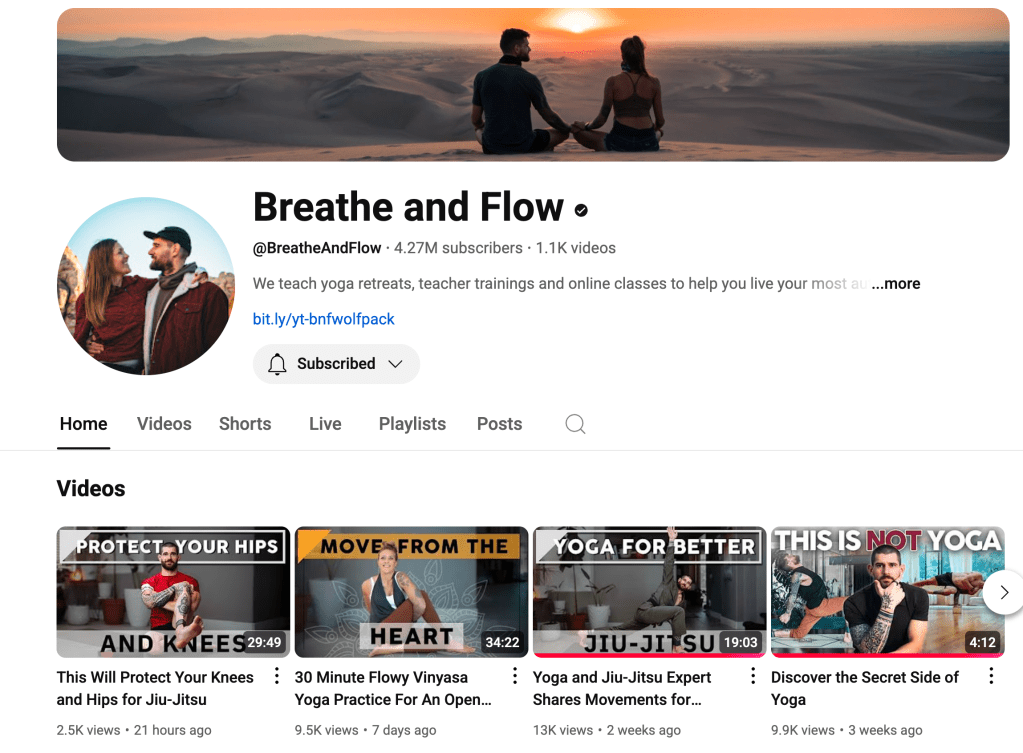
    https://www.youtube.com/@BreatheAndFlow

    I hope it’s legal do put this screenshot here, since I did not contact them in any way. Anyway, I do this for you, so you can get annoyed at people living the perfect life.

    For people not aware of who they are, their names are Brie and Flo (I still love the pun in the name of their channel), and they post videos with guided yoga and meditation sessions, where one of them (or both) performs the movements. They sometimes vlog about their lives, they post on instagram, and maybe more stuff, I don’t know.

    They (mostly Flo actually) are who got me to understand what yoga really is, and I would not have been a daily practitioner if not for their channel.

    Literally every hour of every day, their life is their work. And every hour of every day, they do things that benefit their health, because it benefits their channel.

    And they have kids, and they do yoga while their kids play around them and try to follow their movements.

    And from what I hear, they live in an RV and AirBnbs, so they travel around the world to record from different locations.

    Unless you can work remotely, you only travel abroad on holidays. They do everything for a living.

    And they do everything together.

    If this is not a 16 hour/day/week-complete life, I do not know what is.

    Final thoughts: What can you do?

    I hope reading this has been more inspiring than it was depressing. Your work may already be your happy place, or you may already do “healthy physical activity” with your partner, but if you find that you struggle to find time to fit everything in, you are not alone.

    But you can do it all. It’s not easy, and it may be dangerous and scary.

    But it is possible. And at the earliest opportunity, you should do it.

    But how? I’m still working things out myself, so I’m not the best person to give specific advice on it.

    So let’s think together. Think of the intuition, think of the reason why you need to do this. And at the end of the day, it all boils down to how you multi-task your life bubbles.

    Not by doing more things at the same time, but by achieving more with every single thing you do.

  • Quick Theory: Depression vs Anxiety

    I think a lot about stress, and how it affects us. We sometimes have so much to do, and so little time, that we do not know how to do all of it. Our mind, then, has multiple methods to take them all into account.

    It can pay attention to things.

    It can also block things out.

    But how does our mind’s response affect our state of being?

    Here’s my hypothesis:

    Depression and Anxiety are opposite states of mind.

    But people with mental problems sometimes say that they suffer from “high levels of depression and anxiety”. Well, hear me out:

    Depression and Anxiety originate from the same source. It’s our response that gets us into one or the other.

    But what is the source, and what is the response?

    The source of depression/anxiety is a significant amount of tasks, or things to do, or things to think about.

    In other words, whatever takes over your head space and life. And:

    The response of a person to the source is one’s focus apparatus.

    As in, your ability to think about the tasks that you have to do. You may now think my theory has no footing, but bear with me.

    My theory is that people have a limited ability to multi-task, but they also need something to do: they can’t do nothing. One could say that, when you multi-task too many things, you are stressed, but when you do nothing, you are relaxed. And that is true, if we think short-term (a few minutes to an hour of your time).

    I’m not denying anyone’s ability to multi-task for a short period of time, and I’m not forcing anyone to never “chill”. But please think with me on a longer scale. An entire day, a week, a month, for some years of the following:

    You have to do an overwhelming amount of tasks and you’re thinking about many things: job (maybe multiple), mortgage, debts, kids, school, life in general, politics that will affect you, wars over the borders, maybe arguments with your spouse. One day, it’s too much, and you don’t do any of it. Now, it’s your mind’s job whether to focus on all, one or none:

    • If you focus on one aspect, you are concentrated on it. You can do it, then move onto the next. This is what you have been doing all along, most likely, but things accumulated and you got overwhelmed.
    • If you zoom out the lens, and focus, at the same time, on all the things that you have to do, but you don’t do it, you get anxious about all of them, and how they are affecting or will be affecting you.
    • If you close your lens completely, you don’t focus on anything. A part of you knows there’s all the things that you have to do, but you just have nothing in your mind. You are forced into a state of deep relaxation, you likely are on some substance that is helping you. But it is not energizing. You are not happy. When you have nothing to focus on, you are depressed, because you feel like you have no purpose. You are in a continuous state of “fuck it”.

    But you can see how you can fluctuate from one state or the other. Hell, you likely have been in all these states yesterday. But as long as it does not go on for long, you’re fine. But you likely want to balance your own ability and power, be mindful of your limitation of being able to focus on a single thing at a time, and plan things ahead, to avoid the overwhelming feeling that can direct you towards one state or the other.

    Quick final note

    In summary, depression and anxiety are completely opposite responses to multiple sources of stress. If you take it all in at once, you get anxious about all of them. If you ignore them all at once, you risk falling into a depression. The way to avoid either is to use your limited amount of focus to think about and do one thing at a time.

    I hope you liked this format. Sometimes, I have something short and sweet to note down about life in general, but not so short that it fits into a tweet, so I think I’ll put them here from now on, and separate the blog tabs when I feel in the mood for design.

    Either way, this is a theory based on observation of my own self, as well as my general understanding of what people refer to when they are in either state. If you disagree (or agree even, but have more to say), let’s think together down below.

  • What is your “why”? A story of addiction.

    I think a lot about addiction. You know you have them. Things that you need to do. You may want to stop doing them, but then, there is a feeling. An urge, a thirst, something you cannot control, and it takes over you. If the stars are right, you cannot think, you cannot sleep, you cannot do anything else, unless you give in to it. And if this description reminds you of the “Dark Passenger” from the Dexter tv series, you are right. It is a story of addiction. You can motivate and justify it all you want, but you cannot control it, and there is always a price to be paid, a sacrifice, that you need to give for your giving in.

    We all know the contributors to addiction in society: alcohol, cigarettes, other drugs and substances, but they don’t need to be substances. Social media, porn, video games, sex are just as addictive, if not more, because we tell ourselves “it does not harm my body, so it’s not that bad“. There’s also the addictions that people consider to be good, like workaholism and coffee (yeees, it is an addiction), and the ones we forget are addictions, like sweets and junk food, but they are addictions nonetheless. Why? Because:

    Every action you do compulsively is an addiction

    But what is compulsion? A quick dictionary search gives you this definition:

    Psychology.,  a strong, usually irresistible impulse to perform an act, especially one that is irrational or contrary to one’s will.

    But I have some beef with the definition of a compulsive behaviour as one that is “irrational”. I have the following claim, that I have hinted at in the title:

    Every addiction is rational.

    Wait wait wait, we understand that we rationalise addictions, but them being rational? Well, they are, and it will make more sense when I’ve finally finished my series of the 4 bubbles of life. But for now, I’ll work on intuition with examples:

    You’re in a social situation. You are stressed and insecure, you want to be included in your friend group. Everyone drinks, you’ve seen your family drinking, it’s a relaxed social occasion, so of course you drink yourself. To fit in. Lo and behold, one of your friends lights up a cigarette. Then he directs the pack at the rest of the friend group. A few guys casually get one cig from the pack, and one of the girls decides to say no. She looks uncomfortable, there’s the tiniest twinge in the eyes of everyone that has taken a cigarette already, you hear the tiniest of sighs. You hear what everyone else is thinking “does she think she’s better than us?”. You panic. The pack is in your face. You want to be accepted by the group, everyone else other than her has taken a cigarette. You are stressed, because you saw what reactions she caused. You don’t want to make the others feel bad, you want to stay, you see so many people do it, so it must be alright. So, you take one.

    You see? Perfectly rational.

    From their point of view.

    From the things that were important at that moment in time.

    Priority shifts & Why they’re so difficult?

    You’ve likely said “I’m sorry” when you’ve done something accidentally, when you’ve caused something that you did not mean to happen.

    But did you ever apologise for who you are? For an aspect of yourself so deep, and so engrained, that you believe in it with every fiber of your being, and you believe it is right? If you did, you lied.

    We are hardwired to believe in things, to try to win arguments, to enforce our opinions with more opinions that agree with ours. As the internet and social media has loved shedding light into us, we are more likely to appreciate things that we agree with already, and we will keep doing them longer. We don’t like to be lectured, so if we come across things that disagree with us slightly, we will not engage.

    But life changes, shifts focus. People come and go, jobs change, we stop being students, we no longer have our parents to cook for us. And when these changes occur, we struggle. We are struggle-averse, we do not like to change. People stay in abusive relationships, in jobs that they do not enjoy, they study things that do not interest them, because the change from one to another is difficult. It could be rewarding, but it could be just as bad or worse, so we’d rather rationalise our situation in life.

    So why are people so surprised, then, that an addictive substance, or behaviour, that actively harms us is so difficult to get rid of, when we do things that harm us on a daily basis that we don’t even enjoy?

    At least, our addictive substance gives us the feeling of pleasure. The tingling sensation, the familiar smell (I was going to say good smell, but it is very subjective, isn’t it?), the mouth watering from anticipation. Then the catharsis of going through with the habit.

    It’s our way to escape the stressors of this world. To quiet the mind, and focus on a single thing. If we didn’t have it, the stress would hit so much harder. You’d think to yourself “why do I live anymore, if I can’t have my cup of coffee?”. You don’t eat to live anymore, you live to eat.

    And people have done things for years, maybe decades, by the time some external stressor is telling them to stop. And yes, external. It won’t come from them, it will come from their spouse, from their friends, from their doctor, from their boss, from their aching chest, head, nose, veins, eyes, everything.

    Something will happen to them that will tell them to stop. But they will not stop yet. Because then they need to meet the realisation:

    I have wasted my life on this.

    This means money, time, physical health, real friendships or relationships, activities, nutrients and behaviour that could be good for them but instead, they threw their life and vitality away on some bullshit. And that life will not come back.

    You’ve made your choice, and you lost.

    So you can do the change, and see where that leads you. Or you can double down, the external stressor pulling you deeper into your escape mechanism.

    Possible escape strategy: understand the “whys” and how they apply to your life

    If you suffer from an addiction that you are aware of, this may not work for you. And that is ok, it didn’t work for me either, not at first. Different machines require different fuel.

    But let’s see first if I can cure you of your alcohol addiction. Have an open mind, have a drink, see if you can fit this logic within you.

    What is alcohol:

    Alcohol is a psychoactive, toxic and addictive chemical compound, found in various drinks (and sometimes food), that can relax you connection to your brain’s frontal lobe (the decision-making part).

    The direct benefits are:

    • less inhibition
    • less stress (no more overthinking)

    With the following downsides:

    • brain damage
    • caloric surplus
    • possible addiction
    • other health conditions, like damaged liver, etc.

    I have the following claim for you: alcohol should be drunk. People have been drinking it for the whole of human history, and for good reasons!

    The logic of alcohol:
    Alcohol helps you make friends faster.

    This is the main reason it has been used throughout history. People from different tribes, different cities, different nations, heads of state, the loneliest peasant, they had alcohol to share with guests. If you don’t have much time, but you have a lot of friendship to kickstart, it is the perfect drug.

    For your guests, and for yourself. To prevent overthinking and kickstart trust. We are all friends here already, and we just don’t know it, so a drink helps clarify the matters early.

    But for any other situations, alcohol does not make sense. Why do you drink alcohol when you are:

    • Surrounded by friends at a social gathering?
    • At a family dinner?
    • Alone on the couch?
    • Celebrating anything with friends and family?

    Does it mean that you do not trust your friends and family, and you need it to open up to them? Maybe you did at some point, but why do you need it at every occasion you meet them? Why do you need it when you’re alone? Why do you need to drink it with your spouse and child at home?

    Does it relax you? Ok, fair enough. But what about all other things that can relax you, like hanging out with your friends and family? Which, from what I understand, that is when you are already very likely to drink? Think about it. This tells you something else:

    The problem is not the alcohol. The problem is you, or your “friends”. You feel stressed with them, unless you have a drink? Try not drinking with them, see if they’re still your friends. Then there’s more things you have to motivate, and you’re afraid.

    You’re afraid of letting the ball roll, and see what else it hits in your path.

    END PLAN

    I trust you can extrapolate, from what you’ve seen above, a general plan of action for your own addiction, whatever that is.

    You may not have planned to give up alcohol today, and maybe you didn’t. But this logic (or something similar to it at least) made me do it cold turkey, and many people whose life was completely ruined by it. They gave alcohol a logic, and they realised that logic does not apply to them anymore.

    But there is a final note that I didn’t even plan to address, but it just made sense given my earlier discussion.

    Final note: do not fear stress

    Stress is a feeling that we do not like. We want to avoid it. The more we have it, the worse our life feels.

    And we avoid it however we feel like it. And for many, they avoid it by escaping into something that dulls the stress.

    But stress is not something to fear. Ok, it is, but not in the way of “it is here, I need to fight it”.

    Do not fight it. Flow around it. “Be like water” would say Bruce Lee, and he would not talk only about fighting.

    When you feel a certain stressor from life, it’s your life telling you that “we have a problem here”, which asks you to act! You can fix the problem, like a light bulb that is busted, and you just need to replace it. You can dull it, like work problems which never go away, and you can use alcohol or cigarettes, or coffee and cocaine to work harder on the problem. Those are perfectly viable options to reduce stress.

    But you may not be aware that you can avoid the problem altogether. Your work place may not give your life true meaning. You don’t feel like your work has meaning, or is enjoyable, or you don’t think it helps people as much as you want. You can justify that “someone needs to do this”, or that “it’s very well paid”, and then use the money you get to buy things to dull the pain of working there.

    Or, you can do something that you find meaning and enjoyment from, and you will never work a day in your life.

    And all your stress will go away.

    Don’t get me wrong, it is hard. And the struggle may increase the amount of stress that you are going through. You are in danger of falling even deeper in your escape mechanism, and the other side is not perfect.

    But let’s think together about it. I am a romantic, so this logic gives me hope, that at some point in the future, people will be able to do what they want in life and thrive. Stress will be a thing of the past, and when there is no stress, there is only life.

    And of course, the pains of life that we take enjoyment in creating.

  • Making your life efficient

    This is a follow-up post of the 4 bubbles of life, which you can find here. To summarise, there are 4 cornerstones of a complete life:

    • Health
    • Work
    • Leisure
    • Love

    I would like to define what each category of life activity looks like, what are their benefits and limitations, and by the end of the 4 definitions, I hope I can make a claim that these cornerstones are complete and minimal, as in, there is no other category that fits as a cornerstone of one’s life in a way that is not a subset category of the aforementioned 4, and there is no way to merge either of the categories in a way that doesn’t take away from the meaning of it.

    So let us start with the easy one: Health.

    Definition: A health activity is an action, or a period of time, that is used towards the improvement of ones’ physical health.

    Good examples of the aforementioned are: any type of physical sport, eating (can also be relatively unhealthy food, we’ll get to the distinctions in a bit), sleep, but also nature walks, staying in the sun at the right time etc.

    I have made the focus on the physical health in this category, not that mental health is not important or is not indirectly targeted by physical activity, but because it is targeted by every single one of the bubbles of life.

    This thought literally just came into my mind, so I have to write it down as a corolary.

    Corrolary: All activity bubbles target mental health. There is no activity outside of either of the 4 bubbles that targets psychological health only. However, there are activities that target only the specific activity in each of the categories.

    In terms of health, any form of prescribed recovery-style physio exercise, alongside supplementation, is a form of health activity, without any mental benefits, but no benefits in terms of work, leisure or love either. They unfortunately are the type of activity that, most of us, will consider a chore, so it will not fit in either of the categories.

    Hoping this makes sense. I’m considering whether we could make a claim to give mental health its own bubble or not. For now, I’m trying to keep it separate, because I consider mental health to be the fuel that needs to be balanced by the types of activities from each of the categories. More on that later.

    Now onto the next:

    Definition: A work activity is an action, generally performed over a longer duration of time, that one performs in order to fuel their lives with income.

    I would like to use a very general term for “income” in this instance. This is generally monetary value, but it can also represent favours, or doing something in order to earn value, time, renown, prestige, fame etc.

    You perform a “work” action in order to get some “expendable benefit”. This is a significant cornerstone in everyone’s lives, since without working, in this day and age, we would suffer or die.

    That, or we are already terminally suffering or dying from a condition. Since I have absolutely no knowledge of the types of conditions or people that have to live with a disability, I will refrain from making any form of conjecture on the kind of lives that they can live, and will only generalise my claims to people able in terms of body and mind. I am truly sorry, and I hope you are well and happy.

    I will continue the discussion of work later. Next, in terms of leisure:

    Definition: A leisure activity is an action, or a state of mind, in which one does something (or does nothing) that charges up one (or multiple) of the stores of energy that a human has (i.e. physical energy, mental energy, motivation, etc.)

    In other words, this category of activities helps give you the necessary force to do everything else that you need to do as a human. Without leisure, people enter burnout, become stressed, or maybe literally physically or mentally impaired through overexertion. Many behaviours in this category can intersect the others, but there are a fair few that fit only here, generally bad addictions (i.e. doomscrolling, porn, drugs), but also good habits which have the potential of intersecting work (i.e. painting, learning, playing etc.)

    Finally, we reach the category that I have almost not included, because it felt too close to leisure and/or health.

    Definition: A love activity is an action that is done in a particular state of mind, for the sake of yourself, or another being.

    People more clever than me have tried their hardest to define love, so I will not try to attempt to emulate any of the sorts. These are activities that can fit into other activities, but are not necessarily, or at least primarily motivated by gain, health or chill. In other words, not externally motivated, but internally, against your rationality. Because we are not rational, and we need to be irrational, because we love to love.

    It relates to the times when you make gifts for people, without expecting anything in return, or feeling obliged to make them. It’s when you fix a light bulb, so that both you, and people around you can feel comfort. It’s when you take your pet to the vet, because you can’t bear to feel their pain. It’s when you make your own bed, because you want to do better today than you did yesterday.

    And yes, love activities can also target yourself. You don’t do it enough, and many of your leisure activities aren’t done out of love for yourself.

    Is this a complete model?

    Probably not. There’s too many variables in each person’s life and mind to take them all into account, but for the most part, I believe the essential aspects of everyone’s life is part of one of the bubbles.

    Now, there’s an annex system that I have just realised may be important to bring up. But I can’t take it anymore, I need to share with you a rather significant theory, regarding how your ability (or lack-there-of) to effectively target the 4 bubbles affects how happy and content with your life you are.

    But how you target them has side-effects. And these side-effects will be the topic of our next discussion.

    So bear with me, we’re getting there!

  • The Four Bubbles of Life

    This may sound clickbaity, but it is the most comprehensive theory of life I have ever seen and considered.

    It probably isn’t completely new, but the corollaries are absolutely mindblowing and life changing.

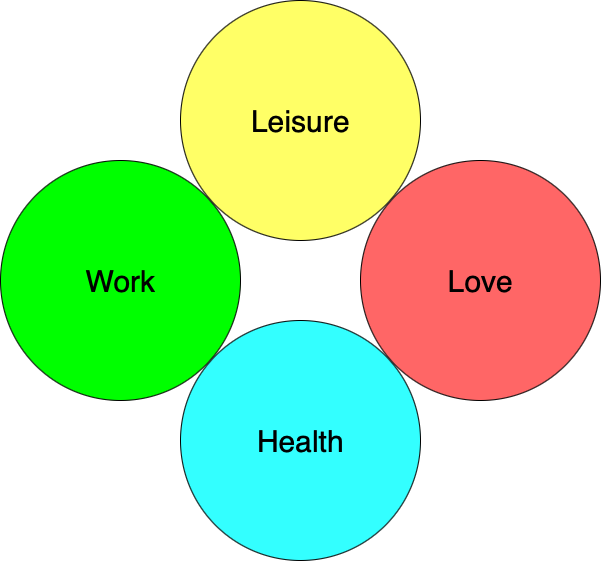
    Here’s a visualising image:

    The axiom is the following:

    Any activity or aspect of life can be catalogued as being a subset of one, or multiple, of the following four aspects: work, leisure, health or love.

    I invite you to prove the aforementioned axiom wrong through one, or multiple counter-examples. I would love to adapt and advance this theoretical model.

    I would like to introduce a concept that should help in expressing a few things that I have in mind, and hopefully explain some of the pains that many of us go through in our life.

    The definition of “life-efficient activity”:

    An activity in one’s life is “life-efficient” if it belongs to an overlap of multiple life bubbles.

    For example: sex. This is a healthy physical activity (health), that you perform to relax (leisure), with your partner (love). By this definition, and the aforementioned model of life aspects, sex is a life-efficient activity.

    The aforementioned axiom and definition make me think of the concept of living a more “complete life”. Not sure if it’s an axiom, or definition, but here it goes:

    A life is “complete” if it targets all life aspect bubbles.

    But by this definition, all lives are complete. We have all, at some point in time, have targeted health, work, leisure and love to a certain extent. But very likely, not all of us do it often enough, or intensely enough, in either of the life aspects.

    A thought just came to my mind. Not sure how much this makes sense, but here it goes:

    Definition:

    A life is “k-hour/day complete” if it targets all life aspect bubbles for at least k hours a day.

    This definition is work in progress, but it finally targets what I’m trying to say:

    Most of our lives are not truly complete.

    Can you say that your life is 1-hour complete? Let’s relax the definition by saying:

    A life is “k-hour/day/week complete” if it targets all life aspect bubbles for at least k hours a day, averaged in a week.

    This relaxation allows people with 4/5 days of 8 hours of work per week to not feel like it’s skewed, or that I’m forcing people to work every day to feel like their lives are complete. But one’s mind generally cannot think further than a week’s time, so I reckon it’s the most reasonable concept to apply for real life.

    Until next time

    Think about how many aspects of your life you are targeting each week, and how does your k-hours/day/week measurement relate to your life. Please note: I theorize this k-value has the potential to reach 16 hours. Maybe you have already figured out how and why. If not, check out the next post, which may have come out already by the time you’ve read this.

    Enjoy life!