Tag: life

  • Culture pushes you to perform

    I think a lot about optimising my performance in everything that I do, and this moved me to learn about the importance of optimising your environment to help you do what you want.

    You want to work more efficiently? Clear your desk. You want to push harder in sports? Eat more clean. Anything else you want to get yourself in? Buy the tools of the trade, learn them, use them well. You probably heard all of this advice already.

    But you’ve forgotten about it. So did I. And then, I watched a video, that recontextualised everything. Well, not directly, so bear with me.

    The video talks about the esports scene surrounding the League of Legends game and, in particular, its Korean player base, whose teams have won 10 out of 15 world league of legends championships. The closest in terms of performance are the Chinese. But why is that, for a game that came out first in America, and has not even had a server in Korea when the first championship happened?

    In short, it’s all about culture. The video goes more in depth with this, but to summarise:

    1. Korea went through a huge economic crisis.
    2. They were bailed out, and sponsorships helped the entire country get connected to the internet (including rural communities) via a combination of high-speed internet and ultra cheap, second hand, good quality PC sales.
    3. The high density of Korea prevents (young) people hanging out easily in public areas. So internet cafes have become highly popular location, since every person takes very little space.
    4. Internet Cafes (or PC Bangs, as they are known in Korea) are extra popular due to the cost (less than $1 per rented unit per person). It is possible to be this cheap due to the aforementioned second hand cheap quality PC sales, and they are so popular, due to the economic crisis.

    This was the perfect background for a free game like League of Legends to break in and take over in popularity, since it added an extra element that was missing from most other games: multiplayer competition (in contrast with Starcraft, the previous most popular game, which was 1v1).

    Western Culture baseline

    If you’re reading this, and you’re from the west, this will likely look like some fanfiction of a science fiction novel, but it is reality. And it is a reality that is very similar to our own.

    Just caused by different reasons.

    Think of Europe and South America. In comparison, the entire continents are significantly less densely populated. This allowed our parents and their friends to play on the streets with the little that they had available, very often being a ball and a couple of stones. As rudimentary as this is, it is enough to set up a mini football game. Everyone, from rich to poor, have the tools and space to play football.

    This is the same starting point, but from the Korean perspective.

    And it does not end here.

    Academic and non-academic support

    You’re probably aware that there are academies for sports, whether that is sports management, or the actual competitive aspect of the sport. There are mentorships, scholarships, sponsorships, amateur competitions, and finally, professional competitions. This is well known due to American movies, since many “jock” characters talk about how they need to perform in their American football games, in order to secure their scholarship for college.

    Well, this is what is happening in Korea right now, but with League of Legends (probably with other video games as well, but I’m not as well informed on the matter). There are academies for esports, mentors and private tutors whose job is literally to improve the gameplay of people, for which parents pay!

    Similarly to how, when a person in Europe or America shows talent and passion in a sport, or a trade, or a science, the parents will support with tutoring, to reach a good institution to improve, and make it into a career, in Korea, you can do that with video games in the esports scene. And you can do it well!

    The only other culture that is coming close to this level of support for the esports trade is China, but is not close enough, and it shows.

    In the west, we still root to the idea that “video games are a waste of time”, that it’s “not real life”. And to a certain extent, I inherently believe that. After all, I’ve been born and raised with these influences. But at the same time, I see the appeal. A part of me would have liked for this to be a valuable career path in my society.

    But a part of me believes it is not. And a part of you likely does as well.

    When culture shapes performance

    So finally, now that we see these examples, we can reach this conclusion:

    The best of the best in anything will come from the places that support those people the most. That which shapes what we value and support in society is culture. Therefore, any competitive field will be won by people from the area whose culture supports that particular field.

    It is why Dagestan keeps producing top fighters for the UFC. It is why the Silicon Valley produces the worlds most profitable startups. It is why the best football players come from Europe and South America, and why the best basketball players come from America. The culture appreciates the art, and therefore supports the art more than any other culture in the world.

    What to do: make your mini-culture

    It is very likely that, if you resonate with this article, something about the culture of the country, or the city, or the school, or the community you live in, does not fit right with who you want to be. A part of you feels misunderstood, and unappreciated, and therefore, the best of you is dormant.

    I therefore highly advise you follow the principle of “make yourself the environment in which you can perform best”, but take it a step higher, just not as far as to take over a country (or do it, who knows, it may be for the better :)).

    I propose you reshape your micro-community.

    The quickest way would be to choose what you want to do, then find the smallest group that is easy for you to meet on a regular basis, and befriend them. That is your people. Love them and support them as if they were your family. If one of you succeeds, all of you will, and turning your passion into your life will become easier than you think.

    The second, more drastic step, is to note which people in your life do not want you to do the things that you want to do. When you can, cut them off. Not easy with family or “close friends”, but it may be for the best. At the very least, see them more rarely, or ignore their advice. They are the influence that you want to minimise, the naysayers, who don’t believe that what you do is worthwhile, or that you will succeed. If you listen to them, you might even start to believe it, and then your dream is over.

    The third, most drastic step, is to move area, city, or even country, to the place where the culture supports what you want to do. If the culture of the place is what you want to do, it will become significantly easier for you do perform your craft. There will be opportunities, even for amateurs. There will be opportunities to improve the skills of your dream, even with sponsorships, if you show talent. For instance, a few hundred years ago, if all you wanted to do is paint or sculpt, you should go to Italy, where you’d find a patron to support your craft, and then sell your work to collectors, which there were tons of wealthy ones, that would come to Italy specifically to find people like you. And on that note:

    A question for you: why did art die?

    Today, I’m rather spent on ideas, but I’m full of questions. And this one is for you.

    I visit museums every now and again, and my jaw drops when I see the sculptures of the Renaissance, the paintings we did around the Italian peninsula. But now everyone needs to be an engineer, into computing, into finance ideally. We live in a culture where money trumps everything, and we abuse every legal loophole we can find to make our money make more money, ethics be damned!

    If you’re an artist, good fucking luck to you, cuz you’re likely on your own. Your parents will try to convince you to become an architect instead, your friends will go do other shit, while telling you that what you’re doing is “cool, but does not matter”. And then you look at the bullshit that you would doodle when you were three, that some people are able to sell for hundreds of thousands of dollars (or millions), and they call it “modern” or “contemporary” art. And you are grinding right now on some math exam for your engineering course that you finally gave in to doing.

    I’m not saying it’s impossible to be an artist, and to find some levels of success. But as opposed to 500 years ago, or earlier, it is bloody difficult. The arts schools are seen as a joke, for people that “don’t take their lives seriously” or are just “taking a piss”. So you have to self-educate, in a world that is pulling you to do literally anything else. Then you have to publish your work for free, to gain interest from social media, and while you do this, you need some way to sustain yourself, either work, parents, or a partner that is willing to be the sole breadwinner until you hit the jackpot. Which, you remind yourself, may possibly never happen. It’s a scary hope, and a dream, that you’ll sideline for a very long time until it becomes reality.

    The culture we live in does not support you, and now with the AI slop that started overtaking the internet, your skill is seen as less and less useful. I’m so afraid we’ll soon forget to write on paper anymore, and one of our first skills that separated the human race from common animals will be lost to time.

    So my question is: how did we lose this part of our culture? If you know when, and how, and what was the last place on this planet that broke under the cultural strain, please share your thoughts.

    And let’s think together.
  • Why it all matters

    This is the planned unplanned fourth part of the “Four Bubbles of Life” series, added to the list for posterity and mentioned here, here and here.

    Quick background: I have axiomised the four essential aspects of life as being the following:

    • Work, which supports your life with value,
    • Health, which prolongs and gives quality to your life,
    • Leisure, which gives you energy, and finally,
    • Love, which is the purpose of your life.

    I may have not defined them in such a way in previous parts, but life has the tendency of changing your mind on things, and their purpose. I may address any discrepancies or confusion some time, maybe down below, maybe in some future post.

    But this post has a different purpose.

    It is to understand why, even though you know what you need to do, at any point in time, there are times when you don’t do it. And times when you burn out. I’m burnt out today, so hoping this will hit you just as hard as it hits me.

    Because you know what you want, and what you need to do. But there is a reason why the balance above needs to be respected, you just don’t yet understand it. I don’t understand it either. But hopefully, we will.

    And the following will help to get an intuition to it.

    Multiple Energy Systems

    When I first came with the 4 bubbles idea in mind, I thought we only functioned on a single energy system, which we fill up through fulfilling leisure activities. And this in turn, allows us to perform the rest of the activities that we need.

    But thinking back on the idea of “work” as a life essential task reminded me: it is an energy system in itself, one which is more palpable compared to leisure. It literally gives us the value (i.e. money, benefits) to do other stuff: eat, drink, pay rent. It literally enables living, it’s an energy system in itself.

    Due to certain situations I lived through, I thought work had a different kind of purpose as well. Literally purpose. I thought that, through work, humans fulfill their need to feel valued, to be of use to their communities. There are, unfortunately, multiple examples of people that die shortly after retirement, and the general consensus is: their lives ran out of purpose, so their lives ran out.

    But giving “work” both these contributions makes it too important, which breaks the metaphorical minimal and maximal division of life aspects which I proposed in the 4 bubbles.

    So, with your permission, I will assign the “purpose” battery to the most fitting life bubble: love.

    It’s the reason why you work, why you keep yourself fit and healthy, and it gives you a very different kind of energy, compared to the one you get from leisure.

    So without further addo, I present my thesis:

    There are 4 energy systems on which humans operate, that enable the performance of all activities. Those are:

    • Value system, supplied by Work activities,
    • Vitality system, supplied by Health activities,
    • Focus system, supplied by Leisure activities,
    • Purpose system, supplied by Love activities.

    Let’s go through each of them, in more depth, to understand why the energy systems are increased if and only if the activity the people are taking are targeting the specific type of life task, and how does the replenishment of one energy system improves your performance in all other life activities.

    Value System: It is mostly about money

    From times immemorial, people needed to work to they could live. Given your likely familiarity with the concept, I will cut short the reasoning behind why you need to work. You know you need to, takes up a large portion of your life, you likely are reading this on your way to or from your work place.

    Furthermore, you likely understand how money allows you to take care of your health, to pay for vacations and concerts and drinks and escape rooms, and if your family needs it, you need to work for it.

    But what happens if you do not earn money? How do you live? We likely do not need to go into unemployment rates, or take notice of the rise in homelessness. You understand all of this, and how important it is.

    But you can have a, dare I say it, meaningful life without working for money. Here is something that I think I need your thoughts on to reason about it better.

    Being a house wife, or house husband. I know it’s a way of working, and a way of living, without earning money per-se. And depending on how wealthy your spouse is in this circumstance, you may not even need to take that much care of the house.

    But in that case, wouldn’t it possibly be the case that you’ve replaced your Work activities with Love activities instead? There’s multiple theories:

    1. It’s still a Work activity, since the remuneration is obtained through enabling the spouse by carrying certain burdens for them.
    2. It’s a mixed Work/Love activity (most likely),
    3. It’s no longer a Work activity, but purely Love tasks.

    I used to consider house chores as being Love activities in one of the previous posts, and obviously, I am having a hard time changing my mind (like everyone else, one of the reason we get stuck in addictions). But I reckon we should make this amendment:

    Corollary: chores are a form of mixed Work/Love activity.

    They are work, since you earn the value that you would otherwise pay someone else to do those chores for you, and it’s love, because you do them to support yourself and your family.

    Vitality System: Mens sana in corpore sano

    Contradicting health advice not-with-standing, everything just feels better when you’re healthy.

    You are more focused on your tasks at work, you perform better for your partner, your laugh is more hearty when you go out with friends, you do not need drinks to have a good time. Nothing hurts, you’re not tired, you feel like the king of the world.

    Then you take advantage of your health, do shit that you know you shouldn’t, eat and drink poison, push your limits, spend longer days, sleep shorter nights, and when all things add up, you cannot:

    • Work anymore, because your focus is off due to drowsiness, or distracted by your pain. Then, you need to take time off, to take care of your multiple sources of pain, which cost you money that you’d otherwise have earned more of.
    • Relax anymore, because you can’t sit back properly without jolts. Maybe you can’t properly get out of a chair, or have a stroll through the park. Maybe that hurt knee and sprained wrist distract you from your yoga session (true story). Maybe you cannot breathe deeply anymore, because you keep inhaling bad stuff intentionally.
    • Spend time properly with your friends, your spouse, your children. Your life’s purpose. Being with them doesn’t cause the same beautiful feeling, because you cannot do everything that they are doing, or enjoy it as deeply. You still get something out of being there for them, but there’s a deep sense of regret when you can’t join them.

    But we forget about our health, until it bites us because we’ve forgotten about it. Unfortunately, as a society, we only see health as something that, when it’s bad, it decreases our quality of life.

    What we forget, or overlook, is that optimising your health is something that can improve your life overall, the baseline can be significantly higher than people expect it to be.

    It’s something that even the self-proclaimed longevity expert Bryan Johnson admitted in one of the podcasts he’s participated in (it was Dr Mike, not Israetel, but the actual medical doctor).

    Disclaimer: I must admit, I am a huge fan of Bryan, I try to apply most of his advice (other than taking pills), and I know he’s crazy. But he’s tenacious, appears to be good natured, and his philosophy helped me immensely to prioritise the things that matter in my life, and that includes my health (to an “unhealthy” extent, some of my friends say). That being said, I needed to include the “self-proclaimed” in his introduction, since he never got qualifications for the title of “longevity expert”. Back to my point.

    He was challenged on his views of optimising longevity, and was asked the following question (paraphrased): “If you were to be told you have only 40 more years to live, would you live those years the same way you do now?”, to which the answer was, arguably not an immediate, but categoric yes. Why? Because the QUALITY of his life has improved to such an extent that he wants to live his life the way he is, even if that will not extend his life any further.

    So guys, learn to learn from the good parts of people, and apply what is useful, dismiss what is useless (quote stolen from Bruce Lee again), and realise the importance and usefulness of your health before it’s too late. You may be surprised with how strong of a high your improved health and athleticism can be.

    Focus System: How much more can you take?

    We all love our weekend. Our chill night on the couch at a movie. A board or video game with friends. A night of eating out and drinking. It’s our time to relax, after a long time doing work, earning our living (literally, as we’ve earlier discussed).

    But why do you need it so much? Do you need it more than me? Do I need it more than you? Don’t you find it weird how some people need to chill more than others, and how others find things like kickboxing or shopping to be so entertaining and happy for them, while others could not even imagine wanting to do either.

    It’s because of the way their mind is set. They see activities differently from you. Even though it’s the same activity, in their mind, it’s something relaxing. And it can be something related to their health, or something they earn money from, or some activity that they perform for their family, with their family.

    But it’s in their head. And this allows them to get energy from the mixed-purpose activity, that they can later use to focus on parts of their lives they do not see as relaxing.

    Get it? A leisure activity is defined by your state of mind. Whenever you feel like doing something, that thing is leisure. Whenever you feel forced to do it, it becomes burden, and you need to spend energy you’ve gathered from other activities. The luckiest people live in a constant state of leisure, and they have enough energy to focus on everything they’ve got.

    It’s a difficult thing to hack though. Your mind does not like to be changed. And worst of all, it does not like to be proven wrong.

    Purpose System: why it all matters

    Throughout history, men have died for their families, for their countries, for their religions, for their freedom. We like to have something to fight for, one way or another. A reason for us to exist, a purpose. Something that we love.

    Because love is not rational, it cannot be explained. You cannot justify the way it started more than you can justify your very existence. But it drives you to do things, things you would rationally not consider doing.

    Some people love fame and money, true, but most of us love each other. Other people, I mean. Specific people that we have chosen (or not chosen, but somehow gotten) into our lives, which we value more than ourselves.

    We will go that extra mile to do everything for them. Or for ourselves, for those lucky few that actually love themselves.

    But what do you do, then, if you love no one? You love nothing? You get lost in time and space, in nothingness. You have no reason to get out of bed in the morning, so you sleep it out forever. You have no reason to focus, so you lose your job. You have no reason to take care of your health, so you start addictions (or the other way around). And yes, there’s no love in your life, so you have no purpose.

    But many-a-times you hear how a specific someone was the one thing that turned the life around for people who lost themselves. The partner becomes the motivation to take care of yourself, so you may take care of them. The children push you even harder, because they’re small and innocent, and you want to protect them from the harshness of life, if only for an extra moment.

    Even if you’re exhausted, you remember them, and you push that little bit forward.

    And everything is worth it.

    It is all worth it

    If you had the composure to go through all my ramblings above, I hope you now have a better understanding of what makes you tick, and what makes you break, and if you’re not in a good state, how to put yourself back together.

    The worst part of this system is also the best part about it: it is interconnected. You break one part, it all falls apart, but if you fix one thing, it spirals into everything becoming better and better.

    It is not easy, to keep it all under control. And there will be times when you miss on one of your energy sources for a little bit too long. But focus on one thing, actually do it, and it will eventually all be ok.

    You have more control than you know, and now, you know how to leverage it. Or at least, you have some system that allows you to think about how to leverage it.

    If you have any further suggestions to the system, please think aloud down below. There must be aspects I’ve missed, and I expect a lot of counter-examples to my statements, cuz I like to generalise, so let me know what you find!

    Otherwise, go live a complete life!

  • Don’t make time for the things that matter; shape what matters to you

    This is the third, and currently, planned final installment of the 4 bubbles of life series. You may find the first and second part linked in the words here somewhere.

    We will start with the axioms we defined in the first post.

    Reminder: there are 4 core aspects of a complete life: work, health, leisure and love. There is nothing more, nothing less. You may not have a complete life unless you hit all aforementioned aspects in a sufficient way in your life.

    And the following formula:

    One’s life is k hours/day/week complete if they have spent at least k hours every day for every one of the 4 mandatory aspects of life, averaged over the course of a week.

    Let me give a simple example: Imagine you have spent at least 1 hour taking care of your health, 8 hours (per work day) working, 1 hour with your family and 1 hour relaxing on the couch, every day, every week, over the course of a few months, you have achieved a 1 hour/day/week complete life.

    Well, hear me out on something.

    What if we take the 1 hour relaxing on the couch and 1 hour spent with your family, and do them at the same time? We get 2 hours of relaxing with your family. What if you go out to walk, picnic on some healthy food and play in the park together (assuming kids), and you re-purpose that 1 hour of taking care of your health doing this instead. You have achieved 3 hours of health, leisure and love every day. And now, your k-life score went up from 1 to 3 hour/day/week complete.

    You may think this is impractical, and you may be right. But I hope you got the right idea:

    One who is able to merge his life goals effectively and efficiently will, in turn, achieve a more complete life.

    Merging Work and Leisure: Influencers

    You’ve probably just sighed quite strongly right now. This case study annoys me as much as it annoys you, but trust me, it’s going somewhere.

    And there is a reason why you hate dislike them so much.

    Their lives are more complete than yours.

    If they are smart (and the most popular of them are), they have merged utterly and completely their work and leisure bubbles into a single, cohesive element: their life is their purpose. If they are even more clever, if they do not enjoy the process of:

    • Filming
    • Editting
    • Scripting

    They will offload it to someone else, and they will focus on the core aspect that they enjoy, be that:

    • creative/informational writing
    • education
    • video games
    • sports
    • tech
    • health
    • comedy
    • whatever other niche they love doing

    And they earn money from this. If you ever went back home from a long day of work, just to play a few hours of your favourite game, you probably understand the frustration of learning of PewDiePie, JackSepticEye and others that do not go to work in the first place: they get to play all day long, if they want. Their purpose, again, is doing what they love.

    Work and Leisure into one.

    You can learn from this, but you don’t need to do what they do. Do something that you enjoy doing, earn money from it, and you will never work a single day in your life.

    Merging Work and Health: Athletes

    Here we have another two bubbles that can be connected, depending on the career of choice: sports.

    Many sports require people to get into their peak physical performance, in order to compete against others that will try to achieve the same thing.

    If you’ve ever went to a football match, or tennis, or basketball, you know: you, or your friends, find it entertaining. It’s a leisure activity for them, to watch feats of athletic and strategic prowess.

    But there is a danger lurking in this field: going too far.

    There’s many-a-times you heard of professional fighters, or power lifters, or any other sport where “health” is taken too far, and it is no longer hitting that bubble. They overexert themselves, to get one extra rep, extra kilo, extra kilometer, maybe some performance enhancing (for fields which still allow, like body building).

    There is a point reaching athletic performances no longer takes care of your health, and it should not be considered a merge anymore.

    So thread carefully…

    Merging Work and Love

    I hate the saying “never shit where you eat”. It’s like today’s day and age truly does not want you to be happy, and people collectively don’t want you to be happy either.

    I find nothing more beautiful than to share your purpose with the one you love. I have been a little inspired, on this matter, by the movie Transcendence. I could make a review if you’re interested, but the main gist was this: they worked together, and when they died, they managed to save their consciousnesses in a little haven, where they could spend eternity together.

    Anyway, back on track.

    If you have a partner, or kids, you likely are going through the pain of not seeing them for the vast majority of your every day (or week), because you need to commute, then work, then commute back. At the very least. Then, you are tired, and the time you spend together is limited to few activities, and unfortunately, some of those activities may even be chores (not leisure).

    Wouldn’t it be so much more rewarding to have been, for the vast majority of your day, side by side with your partner, eating together, helping each other on stressful tasks, and achieve something together every now and then, giving you energy and happiness, and reasons to celebrate?

    Of course, there are downsides. You can both be very stressed, and work-related discussions can get more heated than they would with a random co-worker, but at the same time, work stress can reach home anyway. And instead of having the whole day to resolve stressful situations, in the context of both of you having complete knowledge of the circumstance you both are in, you may take your stress out on your partner anyway, without understanding what the other is going through.

    So there are downsides. But those downsides exist anyway, and overall, working together can turn into a life together.

    Which leads me to the following case study:

    Can you have it all?

    I believe the answer is yes. And this is the proof:

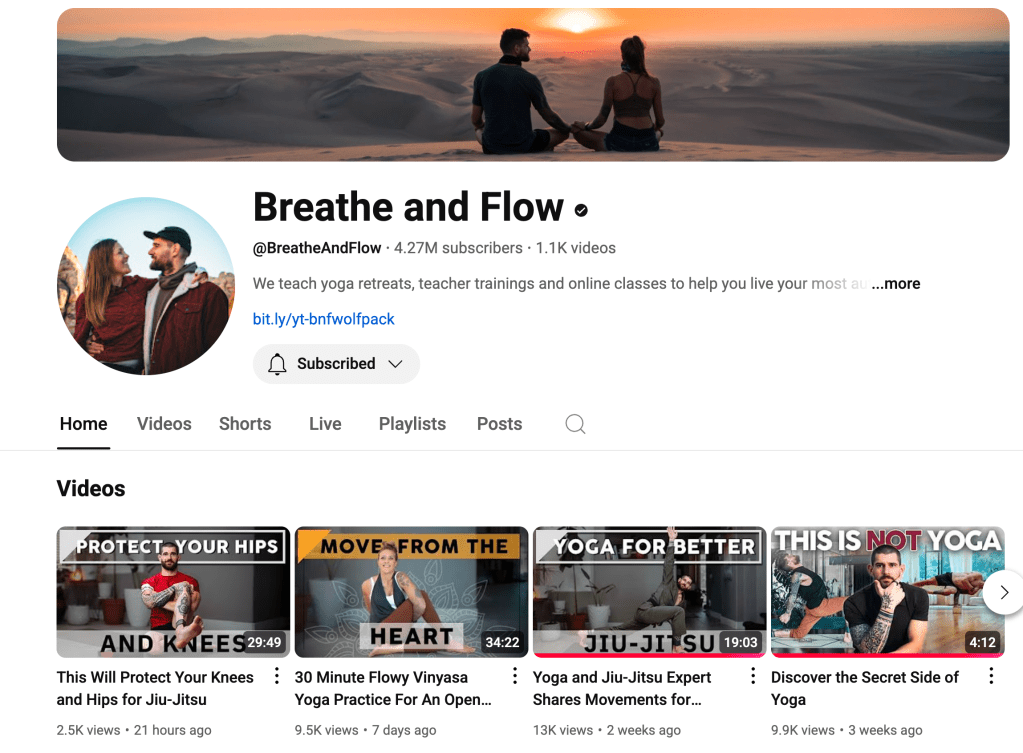
    https://www.youtube.com/@BreatheAndFlow

    I hope it’s legal do put this screenshot here, since I did not contact them in any way. Anyway, I do this for you, so you can get annoyed at people living the perfect life.

    For people not aware of who they are, their names are Brie and Flo (I still love the pun in the name of their channel), and they post videos with guided yoga and meditation sessions, where one of them (or both) performs the movements. They sometimes vlog about their lives, they post on instagram, and maybe more stuff, I don’t know.

    They (mostly Flo actually) are who got me to understand what yoga really is, and I would not have been a daily practitioner if not for their channel.

    Literally every hour of every day, their life is their work. And every hour of every day, they do things that benefit their health, because it benefits their channel.

    And they have kids, and they do yoga while their kids play around them and try to follow their movements.

    And from what I hear, they live in an RV and AirBnbs, so they travel around the world to record from different locations.

    Unless you can work remotely, you only travel abroad on holidays. They do everything for a living.

    And they do everything together.

    If this is not a 16 hour/day/week-complete life, I do not know what is.

    Final thoughts: What can you do?

    I hope reading this has been more inspiring than it was depressing. Your work may already be your happy place, or you may already do “healthy physical activity” with your partner, but if you find that you struggle to find time to fit everything in, you are not alone.

    But you can do it all. It’s not easy, and it may be dangerous and scary.

    But it is possible. And at the earliest opportunity, you should do it.

    But how? I’m still working things out myself, so I’m not the best person to give specific advice on it.

    So let’s think together. Think of the intuition, think of the reason why you need to do this. And at the end of the day, it all boils down to how you multi-task your life bubbles.

    Not by doing more things at the same time, but by achieving more with every single thing you do.

  • Quick Theory: Depression vs Anxiety

    I think a lot about stress, and how it affects us. We sometimes have so much to do, and so little time, that we do not know how to do all of it. Our mind, then, has multiple methods to take them all into account.

    It can pay attention to things.

    It can also block things out.

    But how does our mind’s response affect our state of being?

    Here’s my hypothesis:

    Depression and Anxiety are opposite states of mind.

    But people with mental problems sometimes say that they suffer from “high levels of depression and anxiety”. Well, hear me out:

    Depression and Anxiety originate from the same source. It’s our response that gets us into one or the other.

    But what is the source, and what is the response?

    The source of depression/anxiety is a significant amount of tasks, or things to do, or things to think about.

    In other words, whatever takes over your head space and life. And:

    The response of a person to the source is one’s focus apparatus.

    As in, your ability to think about the tasks that you have to do. You may now think my theory has no footing, but bear with me.

    My theory is that people have a limited ability to multi-task, but they also need something to do: they can’t do nothing. One could say that, when you multi-task too many things, you are stressed, but when you do nothing, you are relaxed. And that is true, if we think short-term (a few minutes to an hour of your time).

    I’m not denying anyone’s ability to multi-task for a short period of time, and I’m not forcing anyone to never “chill”. But please think with me on a longer scale. An entire day, a week, a month, for some years of the following:

    You have to do an overwhelming amount of tasks and you’re thinking about many things: job (maybe multiple), mortgage, debts, kids, school, life in general, politics that will affect you, wars over the borders, maybe arguments with your spouse. One day, it’s too much, and you don’t do any of it. Now, it’s your mind’s job whether to focus on all, one or none:

    • If you focus on one aspect, you are concentrated on it. You can do it, then move onto the next. This is what you have been doing all along, most likely, but things accumulated and you got overwhelmed.
    • If you zoom out the lens, and focus, at the same time, on all the things that you have to do, but you don’t do it, you get anxious about all of them, and how they are affecting or will be affecting you.
    • If you close your lens completely, you don’t focus on anything. A part of you knows there’s all the things that you have to do, but you just have nothing in your mind. You are forced into a state of deep relaxation, you likely are on some substance that is helping you. But it is not energizing. You are not happy. When you have nothing to focus on, you are depressed, because you feel like you have no purpose. You are in a continuous state of “fuck it”.

    But you can see how you can fluctuate from one state or the other. Hell, you likely have been in all these states yesterday. But as long as it does not go on for long, you’re fine. But you likely want to balance your own ability and power, be mindful of your limitation of being able to focus on a single thing at a time, and plan things ahead, to avoid the overwhelming feeling that can direct you towards one state or the other.

    Quick final note

    In summary, depression and anxiety are completely opposite responses to multiple sources of stress. If you take it all in at once, you get anxious about all of them. If you ignore them all at once, you risk falling into a depression. The way to avoid either is to use your limited amount of focus to think about and do one thing at a time.

    I hope you liked this format. Sometimes, I have something short and sweet to note down about life in general, but not so short that it fits into a tweet, so I think I’ll put them here from now on, and separate the blog tabs when I feel in the mood for design.

    Either way, this is a theory based on observation of my own self, as well as my general understanding of what people refer to when they are in either state. If you disagree (or agree even, but have more to say), let’s think together down below.

  • The Four Bubbles of Life

    This may sound clickbaity, but it is the most comprehensive theory of life I have ever seen and considered.

    It probably isn’t completely new, but the corollaries are absolutely mindblowing and life changing.

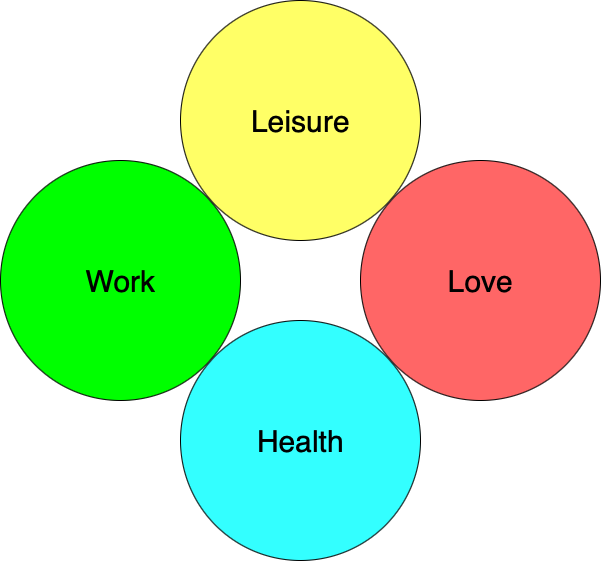
    Here’s a visualising image:

    The axiom is the following:

    Any activity or aspect of life can be catalogued as being a subset of one, or multiple, of the following four aspects: work, leisure, health or love.

    I invite you to prove the aforementioned axiom wrong through one, or multiple counter-examples. I would love to adapt and advance this theoretical model.

    I would like to introduce a concept that should help in expressing a few things that I have in mind, and hopefully explain some of the pains that many of us go through in our life.

    The definition of “life-efficient activity”:

    An activity in one’s life is “life-efficient” if it belongs to an overlap of multiple life bubbles.

    For example: sex. This is a healthy physical activity (health), that you perform to relax (leisure), with your partner (love). By this definition, and the aforementioned model of life aspects, sex is a life-efficient activity.

    The aforementioned axiom and definition make me think of the concept of living a more “complete life”. Not sure if it’s an axiom, or definition, but here it goes:

    A life is “complete” if it targets all life aspect bubbles.

    But by this definition, all lives are complete. We have all, at some point in time, have targeted health, work, leisure and love to a certain extent. But very likely, not all of us do it often enough, or intensely enough, in either of the life aspects.

    A thought just came to my mind. Not sure how much this makes sense, but here it goes:

    Definition:

    A life is “k-hour/day complete” if it targets all life aspect bubbles for at least k hours a day.

    This definition is work in progress, but it finally targets what I’m trying to say:

    Most of our lives are not truly complete.

    Can you say that your life is 1-hour complete? Let’s relax the definition by saying:

    A life is “k-hour/day/week complete” if it targets all life aspect bubbles for at least k hours a day, averaged in a week.

    This relaxation allows people with 4/5 days of 8 hours of work per week to not feel like it’s skewed, or that I’m forcing people to work every day to feel like their lives are complete. But one’s mind generally cannot think further than a week’s time, so I reckon it’s the most reasonable concept to apply for real life.

    Until next time

    Think about how many aspects of your life you are targeting each week, and how does your k-hours/day/week measurement relate to your life. Please note: I theorize this k-value has the potential to reach 16 hours. Maybe you have already figured out how and why. If not, check out the next post, which may have come out already by the time you’ve read this.

    Enjoy life!